Okay, it's common knowledge that the people of N Korea have a problem with food production. They claim it's because of the antiquated ways in which they farm. No, it's because the west is dumping compounds there to retard the growth of crops, a similar trick they tried to use in China, and that they are using in Somalia too, only in China they were trying to spread SARS and the Aids virus and kill the farmers who farmed the land (You didn't know that aids was created by the U.S. as a biological weapon? Read my earlier reports!)but China got wind of it and shot down those planes spreading the poisons. Remember when Colin Powell had to issue that apology to the Chinese government when China shot down that plane trying to spread poison in the countryside of China where food is produced, and China got tired of it and held a press conference to let the world know what they did! President Bush refused to apologize so that China would release the pilots on that plane otherwise they were going to kill them so they conscripted Colin Powell who was then secretary of state to do it. For the Chinese demanded an apology! Of course the U.S. press lied (as usual! Who claims we have a free press?) and said it as for something else. These are things that are going on that the world needs to know about!
The people are starving
Most of the country of North Korea is starving, with a huge
percentage of the population dangerously malnourished, eating rats and
squirrels for sustenance. The country is therefore trying to increase
its arable farmland in order to feed its people. However, due to still
using farming methods from the 1700s, this isn’t really working out,
with people all over the country emaciated and malnourished. North
Koreans who escape to China are easily recognizable for being extremely
thin, and for their tendencies to eat everything they see.
Now the Russians are supposdedly trying to influence the French elections. Now tell me what does the cia, mi6, mossad, french intelligence do? They all try to influence what other countries do. mossad has gone to far murdering Iranian scientists in broad daylight yet the world court hasn't demanded they be brought to justice! Then with all the problems here in this country with racism, classism, and murders by police, as the Lord said you should remove the LOGG from your own eye before you try an remove the speck from your brother's eye!
This anti-Russian/anti-Putin campaign is getting boring. We don't consider this Russian our enemy; our enemies are the ones trying to take away our Healthcare, something we've needed for a long time; and that ain't Putin or Russia who's responsible for this!
Is Russia interfering in the French election? One of Emmanuel Macron's aides claims so
Emmanuel Macron's rival, Marine Le Pen, is anti-EU and a weak Europe would help Russian President Vladimir Putin.
Video:Russia accused of hacking Presidential hopeful Macron
By Mark Stone, Europe Correspondent, in Paris
Emmanuel
Macron, the favourite to win the French presidency, continues to be
targeted by Russia in a parallel campaign of hacking and fake news,
according to his digital campaign manager.
Mounir Mahjoubi has told Sky News that Russia is
behind continued "high level attacks" and its state-sponsored media are
the "first source of false information".
"Let's be precise on that," he said.
"We
are accusing Russia Today (RT) and Sputnik News (of being) the first
source of false information shared about our candidate and all the other
symbiotic ways of working with all these fascist organisations or
extreme right news organisations."
Video:How the US election was 'hacked'
Mr Mahjoubi added: "At the same time, during the same period, with
the same rhythm, we are the victim, the target of hackers on our
servers.
"We have been the targets of multiple attempts of hacking but we succeeded to stop all of them."
Mr Mahjoubi was talking to Sky News at the headquarters of Mr Macron's grassroots political movement, En Marche. :: Who is Emmanuel Macron?
Mr
Macron, 39, the former chief of staff and economy minister for
incumbent French President Francois Hollande, quit the Socialist party
last year to launch his own political movement.
Image:Mounir Mahjoubi, Emmanuel Macron's digital campaign manager, says Russian media are the 'first source of false information'
Distancing himself from "the establishment" has proved to be a draw.
The
former investment banker is now favourite to win the presidency
assuming he makes it through to the second round of the two-stage
process.
He is pro-Europe, pro the euro, centrist and liberal -
stances which Mr Mahjoubi believes make him the target of
state-sponsored hacks.
Video:Macron urges talent to move to France after Brexit
:: How do the French elections work?
"These
ideas of a more open Europe, of a stronger Europe, of a more
progressive France, these ideas for certain countries in the world and
for certain private organisations are ideas to fight against." Mr
Mahjoubi said.
Staff at En Marche were unable to offer any
concrete evidence for the attempted hacks, citing the invisible and
anonymous nature of the hacking process.
But they say their party website and donations website have been disabled temporarily, impacting their fundraising.
"The
only thing we can say is that half of all the attacks come from
Ukraine, but Ukraine is a pass through country, used as a proxy," Mr
Mahjoubi said.
He says the campaign of misinformation is more
damaging, illustrating the problem with a chart showing how inaccurate
news about his candidate can spread in hours.
Video:How the US election was 'hacked'
:: Is the French election Brexit's Waterloo?
Last
month, reports circulated online which raised questions about Mr
Macron's sexuality and his connections to the US banking industry.
Mr Macron was eventually forced to address the rumours, insisting he was not gay and not in the pocket of any US banks.
Yet
since then, Mr Mahjoubi said the "fake news" and the separate hacks
have continued and give an advantage to Mr Macron's main opponent, far
right leader Marine Le Pen.
"Marine Le Pen is our main enemy... Not only her but the ideas of the Front National," Mr Mahjoubi said.
"She now has the support of new media like Russia Today (RT) and Sputnik and that wasn't the case before.
"She has the support of the galaxy of people online which we call the social sphere.
"She has the most effective online troops."
RT and Sputnik, both funded by the Russian state, have strenuously denied ever having published fake news.
"The accusations are false and lack any evidence," Sputnik said in a statement.
RT
added that they "adamantly reject any and all claims that it has any
part in spreading fake news in general and in relation to Mr Macron".
Video:Is this a sign of France's far-right future?
The French government and intelligence agencies have both expressed
concern that Russia is attempting to influence the result of the
election.
The polls suggest a win for Ms Le Pen is an increasing possibility.
She is anti-EU and has called for a referendum on France's EU membership within six months.
A Frexit would cause irreconcilable damage to the European Union - a geo-strategic goal for Russian President Vladimir Putin.
Alexandre Melnik is a former Soviet Union diplomat.
He is now a professor of geopolitics in France and no fan of Mr Putin.
"I
think this is the global strategy of Russia: through cyber war, through
hackers - this is how to kill the fundamentals of western democracy and
to take the global leadership of the 21st century.
"Today, the Kalashnikov perhaps is replaced by one click.
Image:Alexandre Melnik is a former Soviet Union diplomat and says Vladimir Putin uses hacking to interfere with other countries
"We live in this civilisation of 'click' and Putin is aware of that
and so he uses, with strong power, hacking and intervening in internal
affairs of different countries, through one click."
The Kremlin has repeatedly laughed off suggestions that it has meddled in either the US or the French elections.
Kremlin
spokesman Dmitry Peskov said: "We didn't have and do not have any
intention of interfering in the internal affairs of other countries.
"That there is a hysterical anti-Putin campaign in certain countries is an obvious fact."
Now the U.S. military presence supposedly had vacated the Phillipines years ago. Turns out they've been lying to us (big surprise there) for years. Those people want to be left alone but they have made these people endure over a hundred years of war with the United States, the land that's supposed to believe in 'freedom'. See what a crock of shit that really is. No wonder God informs me that the next war (which is coming soon) will completely destroy this country. So you war mongers out there, you're gonna' get your wish soon enough, it just ain't goin' the way you think it will.
Those drug dealers in the Phillipines that their President is executing, must work for the cia, the only reason they're pitching a bitch about him killing them. God is going to destroy this evil governent in the U.S.!
FYI, We Just Won a War in the Philippines
Did you know the U.S. was at war in the Philippines?
An excerpt from my new bookShadow Wars, available for pre-order from Potomac Books.
The
U.S. military battled Islamists in the Philippines beginning in 1899,
when the islands — the spoils of the Spanish-American War — became an
American territory. The fighting raged in fits and starts for the next
hundred years, mostly in the southern region of Mindanao.
By
2001 Mindanao was a haven for a shifting alliance of Islamic groups
dominated by the Moro Islamic Liberation Front (MILF), Jemaah Islamiyah
and Abu Sayyaf — the latter two Al Qaeda affiliates. In December that
year Jemaah Islamiyah plotted an attack on the U.S. embassy in
Singapore, but Singaporean authorities intervened.
Remote
and rugged, the southern Philippines were the tropical analogue of the
mountains and deserts favored by Islamic militants elsewhere. “Pretty much nothing but jungle and mountains and rice paddies,”
is how Rocky Zeender, a former Special Forces soldier who spent three
years in the region, described the terrain. “It was extremely dense
jungle, extremely dense forest, very steep terrain and very difficult to
travel, sometimes impossible to travel, by vehicle, only by foot.”
In January 2002, Special Operations Command
deployed Joint Task Force 510 to fight the Islamists alongside the
Philippine military. The task force would soon change its name to Joint
Special Operations Task Force-Philippines and grow to include 600
soldiers, Marines, sailors, airmen and civilians operating trucks,
gun-armed speed boats, helicopters, C-12 cargo planes and U-28 spy
planes.
Under
the cover of a training exercise in March 2002, Washington sent Gnat
drones — the smaller, slower, older brother of the Predator — to the
Philippines. Comments by a military spokesperson created the impression
that the Gnats were Pentagon assets, but in fact the military didn’t
take possession of its own Gnats until the following year. The Gnats in
the Philippines were apparently CIA models, purchased in parallel with
the agency’s initial contingent of more powerful Predators.
A
photo snapped at Edwin Andrews air base near the southern city of
Zamboanga, where TF-510 was based, showed men in civilian
clothes — probably General Atomics contractors — fussing over a Gnat before or after a mission, with Philippine Air Force OV-10 Bronco attack planes hunched in the background.
The
“training” fig leaf stuck. Philippine law barred foreign forces from
conducting military missions on the islands, so the U.S. task force was
officially limited to advising native forces. The Americans stretched
that definition as far as it would bend. In fact, the U.S. military was
at war in the Philippines, a reality reflected in the drumbeat of American dead.
Accidents
were the biggest killer. On Feb. 22, 2002, an army MH-47 helicopter
exploded and crashed into the sea off the southern Philippines while
returning from a nighttime mission, killing 10 of the 18 people on
board. Four more troops died in accidents between 2004 and 2007. Enemy
ambushes also claimed lives. On Oct. 2, 2002, a bomb packed with nails
exploded outside a cafe in Zomboanga, killing a Special Forces soldier.
Seven years later, on Sept. 28, an improvised explosive device (IED)
struck a Humvee. Two American commandos died.
With
that being said, Philippine troops did most of the fighting, on the
ground, at sea and in the air. With American assistance — valued $15
million a year initially, gradually increasing to no less than $30
million — the country’s ragtag military grew leaner, smarter and more
lethal.
The
OV-10s, numbering a couple dozen at their peak, were the backbone of
the tiny air force and bore the brunt of the intensive bombing campaign
against the southern militants. In May 2000, four Broncos dropped 500-
and 750-pound bombs on a MILF encampment, clearing a path for army
soldiers to seize the base. Forty-three MILF fighters died along with
four government troops.
But
the two-seat, twin-motor attack planes, armed with machine guns and
unguided gravity bombs, were of Vietnam War vintage and badly in need of
upgrade. Lt. Mary Grace Baloyo,
then one of the Philippines’ few female Bronco pilots, was returning
from a training flight when one or both engines apparently failed.
Baloyo’s copilot ejected, but Baloyo stayed in the plummeting bomber
long enough to steer it away from populated areas — and died when it
slammed into the ground. Baloyo’s March 2001 crash was just one in a
tragic litany of accidents that gradually cut the Bronco force in half.
While it’s not clear that the United States provided funding specifically for
the OV-10s’ enhancement, it was only after the Pentagon began
underwriting Manila’s military that the air force, in 2004, finally
signed a $6-million contract for upgrades. American firm Marsh Aviation
provided new engines, each with four propeller blades instead of the
usual three and set up a better maintenance program. The changes
“enhanced the operational capability and readiness of the Air Force,”
the Department of National Defense crowed.
And
that was just a first step. A second round of upgrades seven years
later would transform the Broncos into high-tech, precision bombers
capable of pinpoint raids in the dead of night. Combined with an
expanding force of U.S. drones, the ancient bombers became the
Philippines’ — and by extension America’s — most lethal weapon in the
fight against Al Qaeda’s Southeast Asian arm.
And almost no one beyond the jungle battlefield even noticed.
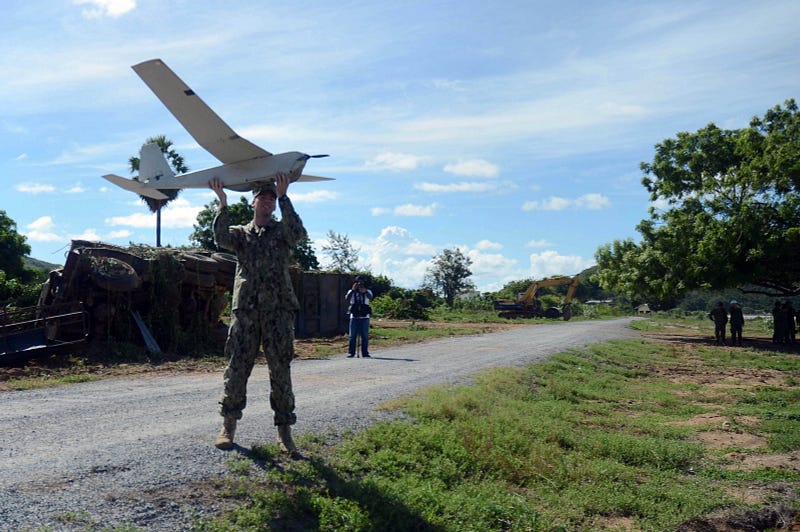
A U.S. Navy sailor launches a Puma drone during an exercise with Philippine forces in Thailand. Navy photo
Drone war
From humble beginnings, America’s drone
force in the Philippines grew in size and sophistication — although the
expansion was rarely officially acknowledged. An offhand mention in
2002 by a military spokesperson of the Gnat drone was one the U.S.
government’s few comments on the robot arsenal in the Philippines in
anything but an emergency context.
Instead,
the drone escalation was marked mostly by its failures and the
destruction it wrought — that is, the damage from robotic strikes plus
crashes and alleged shoot-downs of the flying ’bots. When missiles
exploded and the shattered hulks of downed drones began turning up,
officials were sometimes compelled to explain. And when governments held
their tongues, the drones’ prey — the Islamic militants — did not
hesitate to speak.
In
March 2002 a Gnat plunged into Caldera Bay, 10 miles west of Zamboanga
City. In full view of local seafarers, U.S. Navy SEALs and Philippine
divers recovered the robot “almost fully intact,” U.S. Army Brig. Gen.
Donald Wurster, commander of Special Forces in the Pacific, told local
media. “Nobody got hurt. The pilot is safe,” Wurster joked.
Four
years later on Feb. 10, 2006, an unidentified UAV described as having a
one-meter wingspan — possibly a hand-launched model used by U.S.
Special Operations Forces — crashed into villagers in the mountains on
Jolo Island, a MILF stronghold.
Muslim
villagers, sympathetic to the rebel group, told a TV crew they would
return the white-painted robot to the U.S. or Philippines government for
100,000 pesos — around $2,000. Media reports called it a “ransom.”
There is no indication it was ever paid.
According to the New York Times,
sometime in 2006 U.S. Predators fired a “barrage” of Hellfire missiles
at a militant encampment thought to harbor Umar Patek, an Indonesian
member of Jemaah Islamiyah suspected of helping orchestrate the 2002
bombing of a Bali nightclub that killed more than two hundred people.
Patek
survived. Five years later in January 2011 he was arrested in
Abbottabad, Pakistan, not coincidentally the same town where Osama Bin
Laden was killed by U.S. Navy SEALs in May the same year. An Indonesian
court sentenced Patek to 20years after he admitted making the Bali bomb.
Col.
David Maxwell, commander of the U.S. Joint Special Operations Task
Force-Philippines at the time of the alleged attack, denied the Times’ report. “In all my time in the Philippines in between 2001 and 2007, there has never been a Predator or Reaper deployed, and there have been no Hellfire missiles, let alone ‘a barrage of Hellfire missiles.’”
The
October following the supposed drone-launched missile barrage, U.S.
Marines from the 31st Marine Expeditionary Unit arrived in the
Philippines for a training exercise. They brought along an experimental Silver Fox drone
built by Advanced Ceramics Research, based in Arizona. The 25-pound UAV
with the eight-foot wingspan could support “a wide variety of missions,
ranging anywhere from route reconnaissance, rear-area security, search
and rescue, to battle-damage assessment,” said Cpl. Jesse Urban, one of
the drone’s operators.
“This
is an important asset for us,” Urban said, adding a note of caution
that was already common knowledge among American UAV operators. “The
environment here consists of weather that is less than favorable.”
In
part for that reason U.S. drones continued dropping out of the sky over
the southern Philippines. An unspecified UAV with an eight-foot
wingspan — possibly a Silver Fox struck a coconut grove near Maguindanao
on Oct. 18, 2008, and crashed. U.S. and Philippine officials tried to
cover up the incident, but local reporters broke the news.
Two
weeks later another UAV went down in Talayan, outside
Maguindanao — MILF territory. Rebels claimed they shot it down. A photo
posted online was unambiguous: the ’bot in question was another Silver
Fox.
“The
spy plane is still in good condition and intact and we will not give it
back to the U.S. military,” rebel leader Mohagher Iqbal told a
reporter. “It is now the property of the MILF.”
Not
to be outdone by their American comrades, Philippine troops began
crashing their own homegrown UAVs in rebel territory. Manila’s navy
modified hobbyists’ radio-controlled helicopters for video surveillance.
One of these apparently flew overhead during a “fierce firefight”
between government troops and rebels in Maguindanao in June 2009.
“Commander
Wahid Tundok ordered one his sharpshooters to zero in on the pestering
air vehicle,” MILF told reporters. “And with one shot, it crashed down
in a hillside.”
The
army reportedly tried to buy back the wreckage for 400,000
pesos — $8,000 — but the rebels rejected the offer. Manila denied even
operating the drone. But the evidence of drone warfare outweighed years
of sporadic denials from Manila and Washington. And the best evidence
was in the increasing scale, accuracy and deadliness of government
strikes on MILF and other militant groups in the Philippines.
With
commandos on the ground, upgraded OV-10 bombers overhead and a
veritable armada of robots in support, U.S. and Philippines forces
squeezed and bled the militants over a decade of covert combat.
A U.S. Air Force MC-130 Special Operations Forces transport plane flies over the Philippines’ Subic Bay. Air Force photo
Proxy force
In
mid-2010 the U.S. Congress approved a $19-million package to further
upgrade the Philippines’ small force of OV-10 Bronco bombers. The arms
transfer, handled by Raytheon, included at least 22 500-pound satellite-guided bombs plus the training and technical assistance to use them.
The
first bombs arrived in the Philippines in November that year. The
following month, Bronco pilots sat down with an American expert in
precision munitions. Training ramped up in January, and in March
technicians began modifying the Broncos to carry the new bombs. The
first test drops occurred in May. In June another batch of bombs
arrived.
In
early 2012 the U.S. shadow war on Islamists in the Philippines was a
decade old. U.S. Special Operations Forces — some 700 at their
peak — trained and equipped Philippine forces, fed them intelligence
from drones and satellites and accompanied them into battle.
Seventeen
Americans had died along with some 600 Philippine soldiers. But the
militants suffered proportionally greater losses. In 2002 the U.S. and
Philippine governments printed wanted posters depicting the 24 most
wanted terrorists from Abu Sayyaf, Jemaah Islamiyah, the Moro Islamic
Liberation Front, and other groups. Ten years later, 19 of the
terrorists were dead or in custody.
Before
dawn on Feb. 2, 2012, an informant texted U.S. and Philippine
commanders to say he was with three of the remaining five wanted
men — Zulkifli Bin Hir and Muhamda Ali from the Indonesian Jemaah
Islamiyah group and Abu Sayyaf’s Gumbahali Umbra Jumdail — at a remote
Abu Sayyaf camp on Jolo Island. U.S. troops launched a Scan Eagle drone
that silently orbited over the rebel base, matching observable details
with the informant’s texts.
American
and Philippine commanders confirmed the targets’ identities. They sent
requests up their respective chains of command, seeking approval for an air strike. The replies came back promptly.
Approved.
Two
Broncos, each carrying two of the precision bombs, launched — most
likely from Edwin Andrews Air Base, the Philippine air force’s main
southern outpost in Zamboanga.
The
informant walked away from the encampment, observed the whole time by
the overhead drone. Between 2:00 and 3:00 a.m., the Broncos dropped
their four bombs, pulverizing the rebel base. Survivors stumbled away
under the Scan Eagle’s watchful gaze. Philippine troops were on their
way.
The
informant strolled back into the blast zone to count the dead. Jumdail
had been “obliterated,” Bin Hir was “cut in half,” and Ali was heavily
bleeding and barely breathing, according to the informant’s texts.
Later
there would be official doubt over Bin Hir and Ali’s deaths, but the
blow against the Philippines’ terrorists was a decisive one nonetheless.
Sensing an opening, in late 2012 Philippine president Benigno Aquino extended an olive branch
to MILF, by far the largest of the Philippine insurgent groups. In
exchange for laying down their arms, the Islamists would gain political
autonomy within a new southern Philippine state.
MILF,
perhaps sensing doom in a continued struggle, pounced on the offer. The
rebel group renounced its ties to Abu Sayyaf and Jemaah Islamiyah,
sparking at least one gun battle between MILF and its former allies. In
February this year Aquino visited the rebel stronghold in Mindanao to
finalize a peace deal. The treaty promised to finally deprive terrorists
of their safe haven in the Philippines.
With
the signing of the peace deal, America could tentatively claim victory
in its Philippines shadow war. And in June, Adm. Bill McRaven, head of
Special Operations Command, said the American presence on the
archipelago nation could begin to wind down.
See everyone wants to spew on trump but look here. It's the repugnican party again. Now they're trying to destroy the Affordable Care Act. Now everyone who voted republican need to kick themselves for the repugnicans have been trying to take away your healthcare even before trump came on the scene! They are the most loathesome group ever. It needs to be against the law for anyone to be repugnican trash for they are America's taliban! The worst group of organized crime bosses ever!
The faces of pure evil! Gonna destroy this country and gonna' run like rabbits when the end comes. The king will hunt them down though and bring these devils back to face justice!!!!
Republicans deny Trump one last chance at a 100-day victory and punt on healthcare again
(Getty Images/Pool) After
drawing conservative Republicans on board to the American Health Care
Act, Republican leadership was unable to garner enough support to bring
the bill to the floor this week.
An
amendment released Tuesday night, authored by moderate Rep. Tom
MacArthur, appeared to placate conservatives who did not think the
original AHCA went far enough in its repeal of Obamacare. But pushback
from moderates has seemed to to have stalled the bill for now.
The
White House had pushed for the vote to happen on Friday or Saturday —
making a last-minute play for a signature legislative win in President
Donald Trump's first 100 days — but House leadership announced Thursday
night a vote would not happen until next week at the earliest.
The
push for a new vote came after the MacArthur amendment was released.
New provisions would allow states to apply for a waiver that would
exempt their insurance markets from certain regulations created by the
Affordable Care Act, or Obamacare, if they can prove it would bring down
costs.
The waiver, health policy experts argue, could have negative consequences for people with preexisting conditions and allow insurers to offer plans that cover fewer health needs.
But the amendment may have alienated more moderate members
of the Republican caucus and could leave the AHCA short of the votes it
needs to pass. Only 22 GOP members can vote against the bill for it
pass through the Republican-controlled chamber.
House Majority Leader Kevin McCarthy told reporters on Thursday night that a vote would not happen Friday.
"We've been educating people on healthcare," McCarthy said. "It's not tomorrow. I never said it was going to be tomorrow. We are not voting on healthcare tomorrow."
He also told reporters no vote would happen on Saturday, either.
MacArthur, the author of the amendment and a co-chair of the Tuesday Group, admitted to reporters earlier on Thursday that the Republican conference did not currently have enough votes.
Members of the House GOP conference that originally said they would vote "yes" have now expressed doubts over the amendment. Rep.
Mario Diaz-Balart said "there are a lot of red flags" in the
legislation and that he was undecided on Thursday — he was a yes on the
first version of the AHCA. According to HuffPost congressional reporter Matt Fuller's count, there are 17 Republicans against the bill, 10 leaning "no," and 11 undecided.
The White
House had sought to apply pressure ahead of the 100-day mark in Trump's
administration. Mick Mulvaney, the Office of and Management and Budget
director, told CNBC on Thursday that he was "still holding out" for a
vote on Saturday (Trump's 100th day).
House Speaker Paul Ryan has repeatedly said leadership will not bring the legislation to the floor until "we have the votes."
Passing the AHCA through the House represent a significant hurdle cleared, but it would also lead to new challenges.
Several
Republican senators have expressed serious doubts about the AHCA. And
since Republicans are attempting to move the healthcare bill through the
budget reconciliation process, there have been questions whether the
bill would even qualify under the Senate rules.
Kim
Jong-Un has told North Korea's military to prepare for war against the
United States, saying he wants 'to tear to pieces the Stars and
Stripes'.
He
also said that America does not have a 'monopoly' on nuclear weapons,
adding: 'The U.S. is seriously mistaken if it thinks its mainland is
safe.'
The
comments were made yesterday after America and South Korea held joint
military exercises before announcing another eight-week operation due to
take place from Monday.
Scroll down for video
+6
Kim Jong Un said that America
does not have the 'monopoly' on nuclear weapons, adding that: 'The U.S.
is seriously mistaken if it thinks its mainland is safe.'
+6
The North Korean dictator called
on the army to increase the training of elite units in response to
joint military drills from the U.S. and South Korea on Friday
+6
The aggressive North Korean
statement comes at a time of rising tension on the peninsula after the
communist state also upped its own military drills (pictured, Kim
inspects part of a museum in Pyongyang)
Operation
Foal Eagle will involve around 200,000 South Korean troops and another
3,700 U.S. personnel, spread over land, sea and air.
North
Korea has also recently stepped up its own ground, air and naval
drills, as tensions continue to rise on the fraught peninsula.
KCNA,
the country's state news agency, said: 'The DPRK will wage a merciless
sacred war against the U.S. now that the latter has chosen
confrontation.
'The
prevailing situation where a great war for national reunification is at
hand requires all the KPA (Korean People's Army) units to become
(elite) Guard Units fully prepared for war politically and
ideologically, in military technique and materially.'
Kim
hit out on the same day the U.S. moved a step closer to imposing new
sanctions on North Korea's banks, blocking their access to hard cash.
+6
Kim said he wanted 'to tear to
pieces the Stars and Stripes' and 'wage a merciless sacred war against
the U.S.', according to the country's state news agency
+6
The comments also came as the
U.S. begins ratifying new laws which will place even tougher sanctions
on North Korea, limiting its access to hard cash
The
bill also has that ability to sanction North Korea officials over dire
human rights abuses and individuals who facilitate cyberattacks on the
U.S.
The
new legislation is partly in response to demands for tougher measures
over Pyongyang's nuclear programme and the alleged hack of Sony Pictures
last year.
The
Obama administration last month blacklisted additional North Korean
officials in response to the Sony hack,aimed at reducing the country's
income from illegal weapon sales.
Last
week a U.N. panel investigating how North Korea avoids sanctions
reported that one shipping company caught trying to smuggle jets and
missiles from Cub had simply renamed its vessels, suggesting that the
new sanctions may not be entirely effective.
+6
South Korea and America will
carry out more joint exercises from Monday involving hundreds of
thousands of troops (pictured, Kim inspects the construction site of a
new science and technology centre)
Let me give you a heads up; if you start a war with this guy your gonna lose! God is not with you and so you can have enough nukes to blow up ten planets it won't help you if God isn't with you; and He's not! And the new king isn't going to let you get away; he will hunt you down even if you run to the moon! You will stand trial for your crimes and punishment too for the new king will be one you can strike no bargain with he despises you so! And all others be warned; part from them and have no further business with them or the Lord will see to it you suffer also! These are your final warnings! So save yourself and stand down. white supremacy is a lie and it will be proven in this next war coming. Yes I know the war is coming because your too stupid to understand you've already lost.
So they gave the woman who started this online news rag the boot after they took over. Don't know what to say about that; I personally think it's lousy but who knows, maybe she was no good at the job. Can't say I believe that being she built it up in the first place.
Huffington Post Shrinks Its Name to HuffPost, in a Step Back From Founder
Publication undergoes a rebranding and redesign following co-founder Arianna Huffington’s exit last year
Arianna Huffington, shown
here speaking about Hillary Clinton at the annual LGBT Center dinner on
April 20, left the Huffington Post last year. The site, which she
co-founded over a decade ago, is moving on by shortening its name to
HuffPost.
Photo:
Getty Images
The Huffington Post is officially nudging Arianna Huffington out of its name.
The namesake site co-founded by Ms. Huffington in 2005 is now simply: HuffPost.
Ms. Huffington departed as editor in chief in August to focus on her new wellness startup, about a year after
Verizon Communications
closed its acquisition of AOL, which owned the Huffington Post.
The new streamlined brand comes at a critical time for HuffPost, which recently installed Lydia Polgreen of the New York Times
as its new editor in chief and Jared Grusd as chief executive. As part
of the rebranding effort, HuffPost has also undergone a major site
redesign, unveiled Tuesday.
The brand tweak is likely to garner
the most attention in media circles. The site is trying to pull off a
neat trick: honoring the influence of a founder who at one point
singularly reflected the site’s sensibility, while also proving that
HuffPost is bigger than any one person.
“Arianna’s drive and wit
still flow through HuffPost,” said Mr. Grusd. “The new name is a real
homage to her legacy, but it also sort of moves us forward. The site is
almost 12 years old, and is bigger than just one person. Our identity
now means a lot of things to a lot of people. So this is sort of us
saying, ‘Here’s what we are doing in the new world order.’”
Part
of that new world order includes a new logo and slicker design—one with
hopefully more impactful ads. That means more prominent video ads on
HuffPost’s front page and throughout the site, and more “native” content
produced for advertisers, said Mark Silverstein, HuffPost’s head of
business development and monetization.
The full redesign afforded
HuffPost an opportunity to pare down the list of ad tech partners
employed by the site, which should speed up performance, said Mr.
Silverstein.
HuffPost has undergone a full site redesign with mobile in mind.
Photo:
HuffPost
Plus, HuffPost took this opportunity to ditch a number of ad
units that “nobody wanted anymore,” he said. Over the years, HuffPost,
like many publishers, kept adding new ad types without getting rid of
older ones. “We’d have 16 iterations of essentially the same thing
except one version would have 10 extra pixels or one pixel more,” Mr.
Silverstein said.
In addition to running a shorter list of ad
versions, HuffPost is experimenting with moving around ads and content,
including putting editorial posts on the far right of its pages—real
estate that is typically claimed by ads. It is part of an effort to
fight consumers’ conditioning to turn a blind eye to banner ads, Mr.
Sliverstein explained.
HuffPost
reached over 78 million unique visitors in the U.S. in March, down from
about 82 million during the same month a year earlier, according to
comScore. The site had almost 94 million users in November during the
height of the 2016 presidential campaign.
Overall, HuffPo Media
Group, which also includes AOL News, ranked seventh in March in the U.S.
in comScore’s news and information category.
When Ms. Huffington
created the digital-only news outlet more than a decade ago, it was
envisioned as a liberal answer to the Drudge Report and gained notoriety
as a news aggregator and a blogging platform where most writers weren’t
paid.
It was acquired by AOL in 2011 for $315 million, and Ms. Huffington’s future with the site became somewhat unclear in
the wake of Verizon’s acquisition of AOL in 2015. Then in August 2016,
Ms. Huffington announced she was leaving to focus on her new startup,
Thrive Global, a health and wellness site.
For her part, Ms.
Huffington said she fully endorsed the name tweak and redesign, noting
that many of publication’s social channels and its mobile app already
carried the “HuffPost” brand.
“As the world moves further and
further away from desktop toward social and mobile, it makes perfect
sense to unify the branding,” she said. “For HuffPost to remain strong
it has to constantly evolve.” Write to Mike Shields at mike.shields@wsj.com




 North Korean father-and-son spy team discovered working in...
 US military has become so depleted under Obama it is now...
 Deserted restaurants, beautiful tour guides and absolutely...


